



Choosing a Beach Soccer Field can transform an ordinary sports project into a lively community destination. Sand creates a distinctive playing experience, supports quick movement, and reduces impact during falls. It also gives spectators a relaxed setting, with sunlight, music, and visible action close to the touchline.
FIFA’s Beach Soccer Laws of the Game define the sport’s technical requirements, including field dimensions, markings, playing surface, and safety considerations. These standards help designers plan a credible facility rather than simply spreading sand over unused land. FIFA’s Beach Soccer World Cup UAE 2024 reporting also showed the sport’s international reach, with elite matches attracting strong global attention. Meanwhile, the SFIA 2024 Topline Participation Report identifies soccer as a major participation sport in the United States. That wider demand supports investment in flexible soccer spaces, although it does not guarantee local success.
Angelo Schirinzi, a former Swiss beach soccer coach and recognized FIFA technical expert, has described beach soccer as “a sport where anything can happen.” That unpredictability is part of its appeal. It also demands careful planning. Sand depth, drainage, wind exposure, lighting, ball containment, and wheelchair access all affect daily usability. A poorly drained field can become heavy after rain. In hot climates, surface temperature may discourage afternoon bookings.
The best project combines sport, comfort, and maintenance discipline. Operators should study local participation data before construction. They should also budget for sand replacement and routine grooming. These details are easy to overlook. The field may look simple, but its performance depends on thoughtful engineering and honest post-occupancy review.
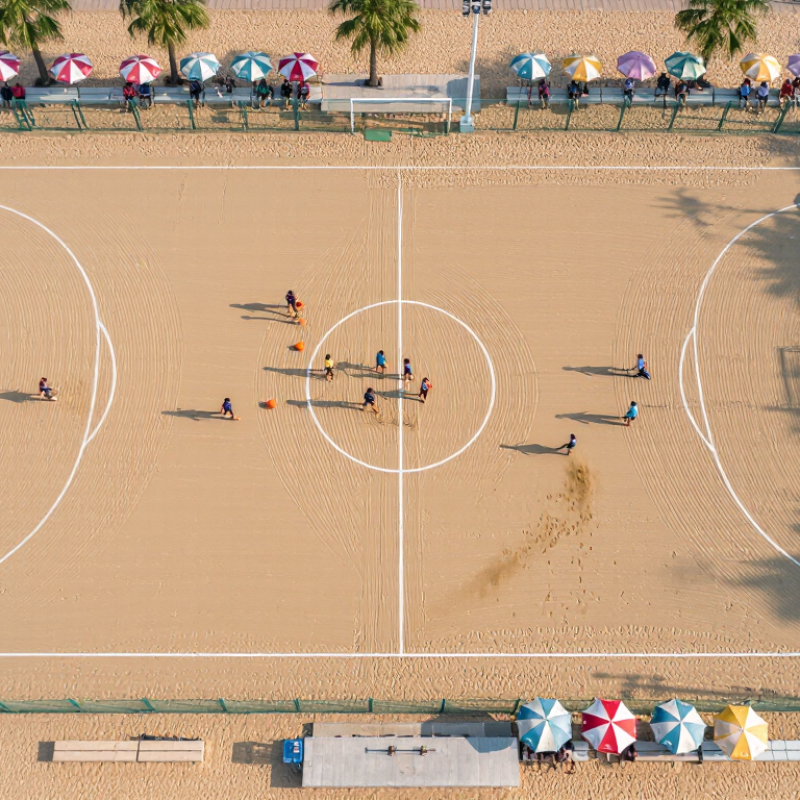
A beach soccer field is a marked playing area covered with clean, level sand. It is smaller than a traditional football field, allowing fast play and closer player interaction. The FIFA Beach Soccer Laws of the Game 2024–25 specify a field length of 35–37 metres and a width of 26–28 metres. The surface should contain at least 40 centimetres of fine sand, without stones, shells, or sharp debris.
These measurements make beach soccer practical for resorts, schools, community parks, and multi-use sports developments. A compact field requires less land, while the sand supports barefoot movement and reduces hard-impact contact. The same FIFA regulations set the goal size at 5.5 metres wide and 2.2 metres high. That proportion creates visible scoring chances from almost every area.
Demand also deserves attention. The 2024 SFIA Topline Participation Report recorded 242.4 million Americans participating in at least one sport or fitness activity during 2023. This figure suggests strong interest in accessible outdoor facilities, but it does not guarantee local demand. That assumption needs testing. Review climate, drainage, maintenance access, and nearby population patterns before construction. Sand can shift after heavy rain. Wind can also change the surface within hours. A field may look ready, yet fail during actual training. Experienced planners should test sand depth, compaction, drainage, and player comfort before approving the final design.



Copyright © CUSTOM Building Products 2025
Products | Resources | Interactive Tools | Warranties | Privacy Policy | Terms of Use | Technical Training
