



Stainless Steel Pipe supports demanding systems, from pharmaceutical skids and food lines to offshore platforms and high-temperature plants. Its polished surface may look simple, yet its performance depends on alloy chemistry, manufacturing method, wall thickness, and service conditions. The wrong choice can create leaks, contamination, or expensive shutdowns.
World Stainless reported 58.4 million metric tonnes of crude stainless steel production in 2023. That scale reflects strong global demand, but it does not make every pipe interchangeable. ASTM, ASME, and ISO requirements still guide dimensions, testing, weld quality, and pressure performance. Market research from Grand View Research also identifies construction, oil and gas, chemicals, and food processing as major stainless steel pipe applications. These sectors demand different solutions.
Corrosion remains central. Materials scientist Pierre R. Roberge stated, “Corrosion is the natural process that converts a refined metal to a more chemically stable form.” His observation explains why grade selection matters, especially in chloride-rich or acidic environments. In this guide, we examine ten important Stainless Steel Pipe types, including seamless, welded, ERW, sanitary, duplex, heat exchanger, and precision options. Each type has a practical role. None is perfect.
Some choices appear obvious. They are not.
A seamless pipe may suit high-pressure service, while a sanitary pipe prioritizes cleanability and surface finish. Duplex stainless steel can offer higher strength and chloride resistance, but fabrication requires greater control. These differences are easy to overlook in a catalogue comparison. This overview therefore focuses on real selection factors: pressure, temperature, corrosion exposure, joining method, inspection needs, and lifecycle cost. A better question is not “Which pipe is strongest?” It is “Which pipe remains reliable in this exact environment?”
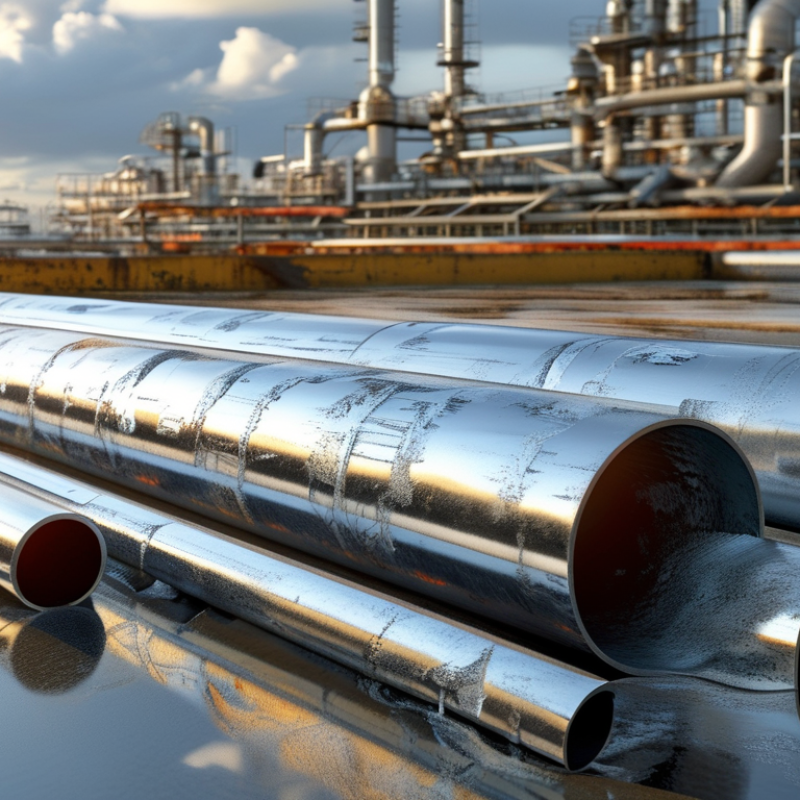
What Are the Top 10 Stainless Steel Pipe Types?
Stainless steel pipe classification starts with manufacturing, shape, grade, and service purpose. The ten commonly discussed types are seamless, welded, ERW, EFW, sanitary, round, square, rectangular, coiled, and large-diameter pipe. These categories can overlap. A round pipe may be seamless, welded, or sanitary at the same time.
Seamless pipe is formed without a longitudinal weld and suits high-pressure service. Welded pipe uses formed plate or strip, then joins the seam. ERW pipe relies on electrical resistance, while EFW uses fusion welding for heavier sections. Sanitary pipe has smooth internal surfaces, polished finishes, and carefully controlled joints. Round pipe handles fluid flow efficiently. Square and rectangular profiles support frames, railings, and structural assemblies. Coiled pipe reduces connection points in long runs. Large-diameter pipe moves substantial fluid volumes.
Material families add another layer of classification. Austenitic grades resist corrosion well and remain workable after forming. Ferritic grades offer magnetic behavior and useful resistance in moderate environments. Duplex grades combine high strength with strong chloride resistance. Martensitic grades provide hardness, although corrosion performance may be lower. I have seen pipe labels cause confusion when shape and grade are treated as the same thing. They are not. Check wall thickness, outside diameter, weld condition, surface finish, pressure requirements, and the material certificate before selection. A polished surface can look reliable, but appearance alone proves little.
| No. | Pipe Type | Primary Classification | Typical Manufacturing Method | Common Stainless Grades | Typical Size Range | Key Characteristics | Typical Applications | Common Reference Standards |
|---|---|---|---|---|---|---|---|---|
| 1 | Seamless Stainless Steel Pipe | Manufacturing process | Made from a solid billet that is pierced and formed without a longitudinal weld | 304/304L, 316/316L, 321, 347, duplex grades | Approximately 6 mm to 610 mm outside diameter; wall thickness varies by specification | No welded seam; suitable for demanding pressure, temperature, and corrosion conditions | Process piping, high-pressure services, power generation, chemical processing | ASTM A312, ASTM A269, ASTM A789, ASME B36.19M |
| 2 | Longitudinally Welded Pipe | Manufacturing process | Plate or strip is formed into a cylinder and joined along one longitudinal seam | 304L, 316L, 321, 347, 904L | Approximately 6 mm to 1,500 mm outside diameter; wall thickness depends on production method | Efficient for larger diameters; weld quality and heat treatment are important design considerations | Water systems, chemical plants, food processing, structural and general industrial piping | ASTM A312, ASTM A358, ASTM A778, ASME B36.19M |
| 3 | Electric Resistance Welded (ERW) Pipe | Welding process | Cold-formed strip edges are joined by electrical resistance heating and pressure | 304/304L, 316/316L | Commonly about 15 mm to 610 mm outside diameter | Continuous production, consistent dimensions, and a narrow longitudinal weld seam | Low- and medium-pressure fluid transfer, water treatment, architectural and general industrial systems | ASTM A312, ASTM A778, ASTM A269 |
| 4 | Electric Fusion Welded (EFW) Pipe | Welding process | Formed plate edges are joined by fusion welding, commonly using arc-welding processes | 304L, 316L, 321, 347, high-alloy stainless steels | Often used from approximately 150 mm to above 1,500 mm outside diameter | Well suited to large diameters and heavier wall thicknesses; weld examination may be specified | Large process lines, chemical equipment, storage and transfer systems | ASTM A358, ASTM A671, ASME B36.19M |
| 5 | Spiral-Welded Stainless Steel Pipe | Forming and welding configuration | Coil or strip is helically formed and welded along a spiral seam | 304L, 316L, duplex stainless grades | Commonly about 400 mm to 3,000 mm outside diameter, depending on equipment and specification | Economical for very large diameters; the spiral seam requires appropriate inspection and design review | Large-diameter water conveyance, cooling-water systems, exhaust and low-pressure services | Project-specific specifications; applicable requirements may reference ASTM A778 or A358 |
| 6 | Sanitary Stainless Steel Pipe | Surface finish and hygienic design | Usually precision welded or seamless, with smooth internal surfaces and sanitary end preparation | 304L, 316L | Common tube sizes range from 6 mm to 300 mm outside diameter | Low-crevice design, cleanable surfaces, polished internal finish, and hygienic fittings | Food and beverage, dairy, pharmaceutical, biotechnology, and clean-process systems | 3-A sanitary criteria, ASME BPE, ASTM A270 |
| 7 | Instrumentation and Small-Bore Tube | Product form and precision service | Cold-drawn seamless or welded tube produced to close dimensional tolerances | 316/316L, 304/304L, nickel-bearing stainless alloys | Approximately 3 mm to 50 mm outside diameter; wall thickness is commonly specified precisely | Good dimensional control, clean bore, and suitability for high-integrity connections | Instrumentation lines, hydraulic systems, gas panels, analytical equipment | ASTM A269, ASTM A213, ASTM A632 |
| 8 | Heat-Exchanger and Boiler Tube | End-use classification | Seamless or welded tube, often supplied with controlled chemistry, dimensions, and heat treatment | 304L, 316L, 321, 347, 309, 310 | Commonly about 6 mm to 50 mm outside diameter, with thin to medium wall thickness | Designed for heat transfer, resistance to oxidation, and service at elevated temperatures | Heat exchangers, condensers, boilers, heaters, and thermal processing equipment | ASTM A213, ASTM A249, ASTM A789, ASTM A688 |
| 9 | Ornamental and Decorative Stainless Steel Pipe | Appearance and architectural use | Usually welded and polished, brushed, or supplied with another specified surface finish | 201, 304, 304L, 316, 316L | Commonly about 12 mm to 200 mm outside diameter | Prioritizes appearance, surface uniformity, formability, and corrosion resistance in normal environments | Handrails, balustrades, furniture, shopfitting, façades, and interior design | ASTM A554; project-specific dimensional and finish requirements |
| 10 | Duplex Stainless Steel Pipe | Metallurgical grade classification | Seamless or welded pipe made with a ferritic-austenitic stainless steel structure | 2205, 2507, 2304, 2509-type super duplex grades | Approximately 6 mm to 1,000 mm outside diameter, depending on product form | Higher strength than common austenitic grades and strong resistance to chloride stress-corrosion cracking | Offshore equipment, desalination, chemical processing, marine systems, and oil and gas piping | ASTM A790, ASTM A928, ASTM A789, ASME B36.19M |
| Note: Size ranges are typical industry ranges rather than universal limits. Actual outside diameter, wall thickness, pressure rating, surface finish, grade, heat treatment, and testing requirements depend on the applicable specification and project design. | ||||||||



Copyright © CUSTOM Building Products 2025
Products | Resources | Interactive Tools | Warranties | Privacy Policy | Terms of Use | Technical Training
