



Glass Railing Standoffs are compact hardware components that secure glass panels to walls, stairs, decks, or structural frames. They create a clean gap between the glass and its support. That gap improves visual lightness and allows easier cleaning around the panel edges. In a coastal home, stainless steel standoffs may face salt spray, wind, and frequent moisture. In an indoor stairway, the same fittings may experience less corrosion but more daily contact.
Choosing the right standoff requires more than matching a shiny finish. The glass thickness, panel size, fixing surface, load direction, and installation location all matter. Check the manufacturer’s technical data before ordering. Confirm the recommended bolt type, drilling diameter, spacing, and tightening torque. A qualified installer should also inspect the substrate, because strong hardware cannot compensate for weak concrete or poorly reinforced framing. Local building requirements may influence height, spacing, edge protection, and impact resistance.
Material selection deserves careful attention. Grade 316 stainless steel usually offers stronger corrosion resistance than Grade 304 in harsh outdoor environments. However, the label alone proves little. Product quality, fabrication accuracy, and maintenance still affect service life. A polished surface can hide poor threads or uneven tolerances. That is easy to overlook.
Some projects need custom standoff lengths or concealed fixings. Others benefit from adjustable designs during alignment. Samples help reveal how the hardware looks beside the actual glass and flooring. A thoughtful choice balances safety, durability, appearance, and installation practicality. The best result is not merely attractive; it remains stable, inspectable, and reliable over time.
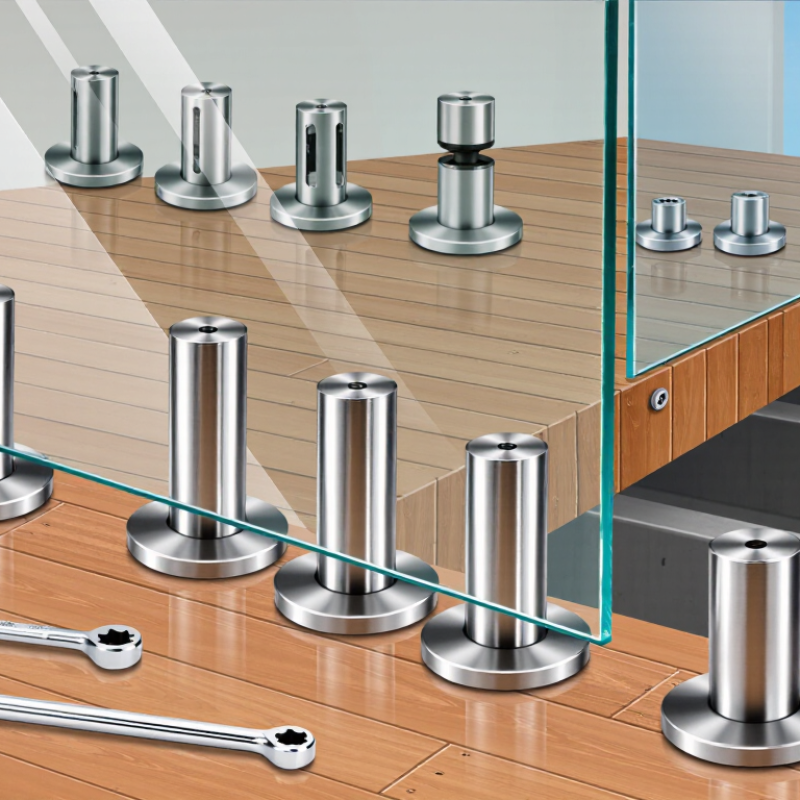
Glass railing standoffs are compact metal fittings that hold glass panels away from a wall, stair stringer, or supporting frame. They usually contain a cylindrical body, threaded bolt, washers, and protective gaskets. The glass sits between the washers, creating a clean, floating appearance without continuous posts.
They are not decorative buttons.
Most standoffs use stainless steel because moisture, fingerprints, and cleaning chemicals can attack weaker finishes. The correct design depends on glass thickness, panel size, fixing surface, spacing, and expected loads. Tempered or laminated safety glass is normally required, but the final specification must follow local building rules and an engineer’s calculations. A 2023 Grand View Research report estimated the global flat glass market at about USD 118 billion in 2022, with construction as its leading application. That scale reflects why installation quality matters.
Choose a standoff with a load rating supported by test evidence, not appearance alone. Check the substrate before drilling. Concrete, steel, and timber need different anchors and edge distances. Gaskets must separate metal from glass; direct contact can create concentrated stress and delayed cracking. A common mistake is selecting longer standoffs for visual depth without checking bolt engagement. That choice can weaken the connection. Another imperfect assumption is treating every stainless-steel grade as equally suitable near coastal air. It is not. Review corrosion resistance, drainage, maintenance access, and replacement availability before approving the layout.
| Selection Dimension | Typical Options or Values | What It Means | Recommended Selection Guidance |
|---|---|---|---|
| Definition | Metal mounting cylinders, also called standoffs or glass spigots | They hold a glass panel away from a wall, fascia, stair stringer, or other supporting structure. | Choose a system designed specifically for structural glass railing use rather than general decorative hardware. |
| Glass type | Tempered, laminated, or tempered-laminated safety glass | The glass construction affects safety, thickness, drilling requirements, and how the panel behaves if damaged. | Use safety glazing appropriate for the application and confirm whether the standoff system is compatible with laminated glass. |
| Common glass thickness | 10 mm, 12 mm, 13.5 mm, 15 mm, or 19 mm | Thickness is normally specified in millimetres and must match the hardware opening and gasket system. | Measure the actual glass specification before ordering. Do not force a panel into an undersized opening. |
| Standoff diameter | Approximately 38–50 mm for many railing applications | The diameter is the visible round face of the standoff and contributes to the appearance and bearing area. | Select a diameter that is approved for the panel thickness and required design load; a larger face is not automatically stronger. |
| Projection from support | Approximately 25–50 mm, depending on the system | Projection determines the clearance between the glass and the supporting surface. | Use the shortest projection that provides the required clearance, drainage, cleaning access, and edge protection. |
| Material | Stainless steel, commonly 304 or 316 grade | Material affects corrosion resistance, strength, maintenance, and suitability for indoor or outdoor exposure. | Use 316 stainless steel for coastal, marine, poolside, or high-chloride environments where greater corrosion resistance is needed. |
| Surface finish | Satin/brushed, polished, or powder-coated finish | Finish controls appearance and can influence how visible fingerprints, water spots, and scratches are. | Choose a finish compatible with the environment and clean it according to the material supplier’s instructions. |
| Mounting surface | Concrete, structural steel, timber, masonry, or engineered framing | The support must transfer the railing loads safely to the building structure. | Identify the substrate before selecting anchors. Surface finishes, cladding, and nonstructural sheathing should not be treated as the primary support. |
| Anchor type | Through-bolts, expansion anchors, chemical anchors, or structural screws | The anchor transfers tension, shear, and overturning forces from the standoff to the structure. | Select anchors based on the substrate, edge distance, embedment depth, corrosion exposure, and verified load requirements. |
| Glass connection | Pre-drilled hole with sleeves, gaskets, washers, and caps | The glass is clamped or supported through prepared holes while soft components isolate the glass from metal. | Use the specified hole diameter, edge distance, gasket material, and tightening procedure. Never drill or modify tempered glass on site. |
| Hole location | Determined by panel size, standoff diameter, edge distance, and structural design | Incorrect hole placement can increase glass stress and reduce the effective panel capacity. | Provide the fabricator with a dimensioned drawing before glass production and follow the approved system details. |
| Standoff spacing | Project-specific; often arranged at panel corners and intermediate points | Spacing affects panel deflection, fastener forces, hole stresses, and the amount of hardware visible. | Do not select spacing from appearance alone. Have the panel dimensions, glass build-up, loads, and support conditions checked together. |
| Handrail requirement | Top rail, cap rail, or approved frameless configuration | Some locations require a graspable handrail or top rail independently of the glass support method. | Check local building regulations for handrail height, continuity, graspability, opening limits, and impact-safety requirements. |
| Indoor or outdoor use | Interior, exterior, poolside, marine, or industrial environment | Moisture, salt, cleaning chemicals, temperature changes, and pollutants influence service life. | Match the stainless-steel grade, finish, fasteners, sealants, and maintenance plan to the exposure conditions. |
| Compliance and engineering | Local building code, structural calculations, product test data, and installation instructions | Railing design may need to resist concentrated loads, uniform loads, impact, wind, and other project-specific actions. | Confirm the complete assembly with a qualified designer or engineer before fabrication and installation. Hardware alone does not establish compliance. |
Note: Dimensions shown are common planning ranges, not universal requirements. Final glass thickness, hole details, standoff spacing, anchors, and load capacity must be verified for the specific project and applicable local regulations.



Copyright © CUSTOM Building Products 2025
Products | Resources | Interactive Tools | Warranties | Privacy Policy | Terms of Use | Technical Training
