



Outdoor security lighting is becoming more accessible as solar power expands, but a bright product photo proves very little. Choosing a Solar Motion Flood Light means balancing useful brightness, dependable sensing, battery capacity, and sunlight exposure. The right choice should illuminate a gate, driveway, or garden path when needed—not merely look powerful on a product page. Small details matter.
IRENA’s Renewable Capacity Statistics 2024 reports that global solar capacity grew by about 346 gigawatts in 2023. This figure describes the energy sector, not the performance of individual lights, but it shows how rapidly solar technology is scaling. The U.S. Department of Energy notes that LED lighting uses at least 75% less energy than incandescent lighting. That comparison offers useful context, not a guarantee that every solar floodlight will shine brightly all night. Weather, shade, battery condition, and sensor settings all affect real-world results.
This guide explains how to compare lumen ratings, motion-detection range, sensor angle, battery specifications, and weather-resistance claims. It also considers where the panel will sit: a south-facing, sunlit wall may perform differently from a shaded corner beneath an eave. Check whether the light allows adjustable brightness and detection time. Those controls can help conserve stored energy. One point deserves skepticism: advertised runtime often reflects ideal test conditions. A clear specification is helpful; an independent test is better.
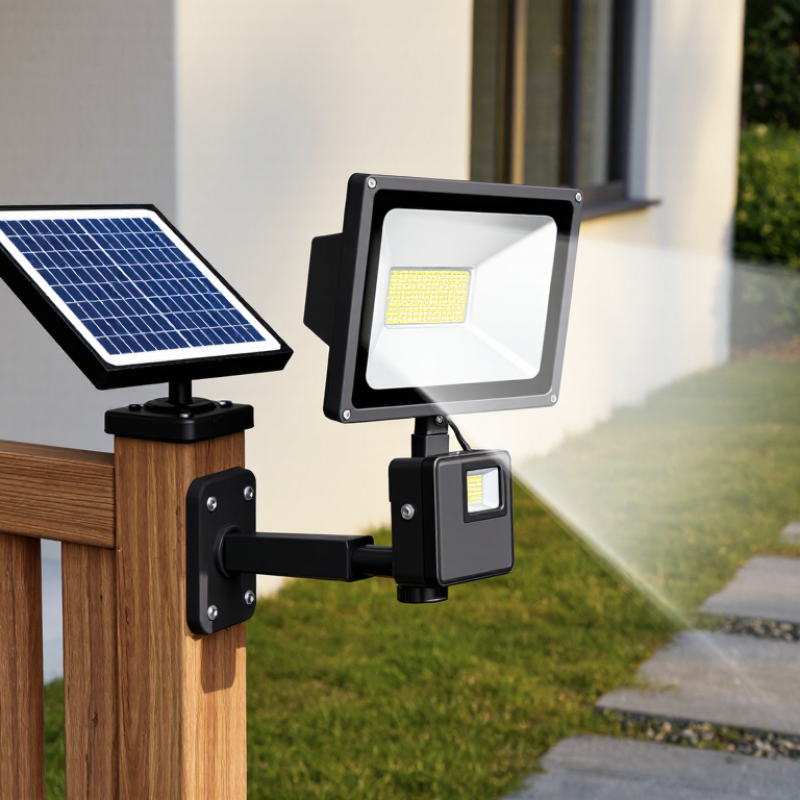
A solar motion flood light works as a compact, off-grid lighting system. In daylight, photovoltaic cells convert sunlight into electricity, while a charge controller directs power into a rechargeable battery. At dusk, a photocell enables the light’s motion-sensing mode, which uses little power while waiting for activity.
A passive infrared sensor detects changes in infrared energy, such as a person moving through its detection zone. When triggered, the control circuit sends battery power to the LED array for a set period. The lamp then dims or switches off until it detects movement again. That cycle saves energy. Detection is not exact, though: passing branches, nearby warm surfaces, or a poorly aimed sensor can cause unwanted activation or missed movement.
Performance depends on charging conditions as well as sensor design. A panel shaded by eaves or winter tree cover may not recharge the battery fully, even if the lamp still turns on. Place the panel where it gets several hours of direct sunlight, and aim the sensor across a path rather than directly toward it. Check whether the panel is attached to the light or connected by a cable; a separate panel can help in a shaded spot. It is tempting to judge a light by brightness alone. Runtime matters too.



Copyright © CUSTOM Building Products 2025
Products | Resources | Interactive Tools | Warranties | Privacy Policy | Terms of Use | Technical Training
