How to Choose Decorative Veneer Plywood in 2026?
Choosing Decorative Veneer Plywood in 2026 requires more than matching a color sample to a room. The surface may look perfect under showroom lights, yet reveal uneven grain beside a window. Real projects teach this quickly. Appearance matters, but performance decides whether the material earns its place.
This guide examines veneer species, plywood grades, core construction, thickness, moisture resistance, and surface finish. It also considers emissions documentation and responsible sourcing. Ask suppliers for technical data, test reports, and clear warranty terms. A trusted manufacturer should explain how the panels were produced, not only display attractive photographs. Check the veneer for consistent slicing, open defects, bubbling, and mismatched edges. Run your hand across the sheet. Small irregularities can become obvious after installation.
Design trends change quickly, while cabinetry and wall panels often remain for years. Warm oak, smoked walnut, ash, and textured finishes may dominate current interiors. They still need to suit lighting, maintenance routines, and the building’s climate. Samples should be viewed at different times of day. They should also be tested against the actual hardware and paint.
No checklist is flawless. Human judgment still matters. A cheaper panel may reduce the budget today, but replacement costs can erase that advantage. Conversely, premium plywood is not automatically the best choice. Compare verified performance with the project’s real demands. With careful inspection and honest supplier communication, buyers can choose Decorative Veneer Plywood that balances beauty, stability, safety, and long-term value.
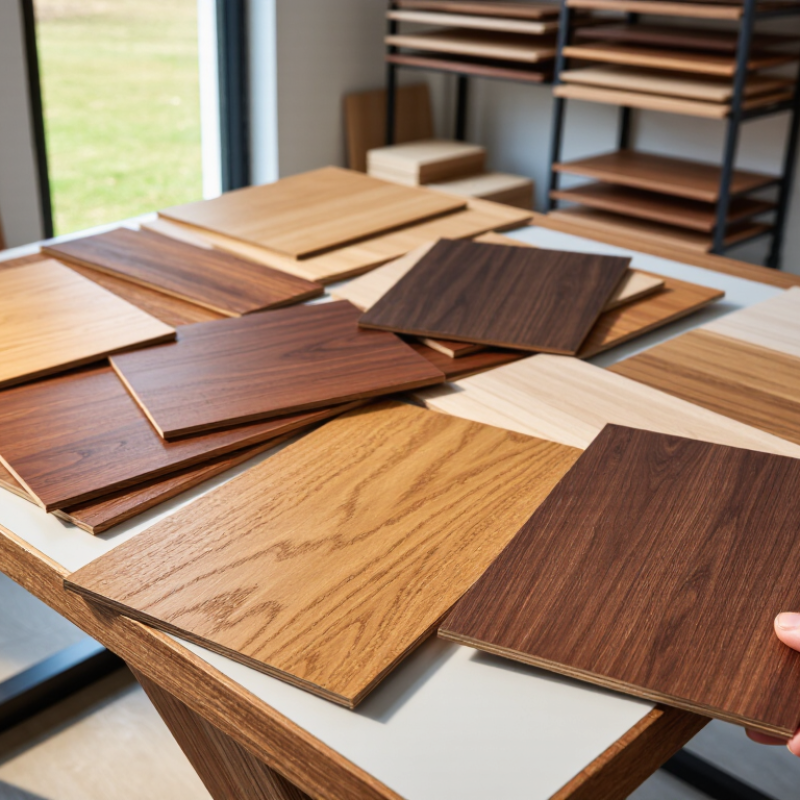
Define Design Needs: Match Veneer Species, Grain, and 0.5–1.5 mm Face Thickness
How to Choose Decorative Veneer Plywood in 2026?
Define Design Needs: Match Veneer Species, Grain, and 0.5–1.5 mm Face Thickness
Start with the room, not the catalog. A calm bedroom may suit pale oak, ash, or maple with straight grain. A dramatic reception desk might need walnut tones and a stronger cathedral pattern. Check the veneer under the project’s actual lighting. Warm lamps can make yellow wood appear richer than expected. Daylight tells a different story.
Choose grain direction before ordering panels. Long, consistent grain can make cabinet doors look taller. Book-matched sheets create symmetry, but small color shifts remain normal. Request a larger sample, not just a palm-sized chip. I have seen attractive samples look unbalanced across a full wardrobe. That mistake is expensive.
Face thickness deserves equal attention. A 0.5 mm veneer keeps panels light and economical, but it offers limited sanding tolerance. A 1.0–1.5 mm face usually handles minor surface preparation more safely. Confirm the plywood core, adhesive quality, and panel balance with the supplier. Thin faces can telegraph sanding marks or core irregularities. Inspect edges after cutting. They reveal problems quickly. Moisture exposure also matters, especially near sinks or unsealed windows. The perfect species may still be the wrong specification.
Check Moisture and Bond Quality: Target 6–14% Moisture Under EN 636
Choosing decorative veneer plywood in 2026 starts with moisture, not appearance. A flawless face can hide unstable layers. For interior panels, I check each delivery before cutting. The practical target is 6–14% moisture, while EN 636 service classes guide the final decision. This range should match the panel’s environment and project specification. It is not a substitute for documented testing.
Use a calibrated moisture meter on several sheets, not one convenient sample. Measure near corners, the center, and freshly exposed edges. Record readings beside batch numbers and room conditions. A wide reading spread deserves attention. So does swelling around screw holes. Let panels acclimatize on spacers in the installation room. Keep them flat, dry, and away from direct heat. Small details matter.
Moisture is only half the inspection. Bond quality determines whether veneer layers stay intact after machining or humidity changes. Look for open joints, bubbling, edge separation, and dark glue lines. Ask for production records and test evidence linked to the supplied batch. EN 636 classifies plywood for use conditions, while bonding performance may require the relevant EN 314 assessment. That distinction is easy to miss. I once accepted a uniform meter reading too quickly, then found weak bonding near an edge. Physical checks still matter. When results conflict, hold the sheets and request independent testing before installation.
How to Choose Decorative Veneer Plywood in 2026?
Check moisture and bond quality before purchase. Use a moisture meter to verify a target reading of 6–14%, then match the plywood exposure class with the appropriate EN 314-2 bond quality class.
Reference framework: EN 636 exposure classes 1–3 and EN 314-2 bond quality classes 1–3. The 6–14% moisture range is a practical screening target for decorative plywood selection.
Confirm Emissions Compliance: Require E1 ≤0.124 mg/m³ or CARB Phase 2
Decorative veneer plywood should be judged by its core emissions, not its surface appearance. The European EN 717-1 classification defines E1 as formaldehyde emissions at or below 0.124 mg/m³. This figure comes from chamber testing under controlled temperature, humidity, and loading conditions. It is not a lifetime guarantee for every room.
CARB Phase 2 uses different limits and test methods. CARB ATCM 93120 sets formaldehyde limits at 0.05 ppm for hardwood plywood, 0.09 ppm for particleboard, and 0.11 ppm for medium-density fiberboard. U.S. EPA TSCA Title VI guidance recognizes these limits for compliant composite wood products. Ask suppliers for current laboratory reports, product thickness, substrate type, test method, and production date. A certificate without traceable test details is weak evidence. I have seen attractive panels fail basic document checks.
Tips: Request both the E1 result and CARB Phase 2 evidence when projects cross markets. Compare the test method, not only the number. Keep delivery labels, batch records, and reports together. Store panels in a ventilated, dry area after arrival. Emissions can change with humidity, and one factory report may not represent every batch. Perfect paperwork is rare, so verify what remains uncertain.
Evaluate Surface Grade and Finish: Inspect A-Grade Faces Under ISO 2426 Standards
How to Choose Decorative Veneer Plywood in 2026?
Evaluate the surface grade and finish before comparing color or price. Under ISO 2426, confirm the required appearance class for the visible face. Do not assume every “A-grade” label means the same quality. Inspect the actual panel, not only a digital photograph.
Use neutral daylight or balanced showroom lighting. Look across the face at a shallow angle. Check for open knots, repaired areas, splits, mineral streaks, uneven veneer matching, and sanding marks. The surface should feel consistent under your fingertips. A tiny defect may seem harmless. It can become obvious after clear coating. Also inspect the reverse face and edges, especially for furniture doors and exposed shelving.
Tips: Request a full-size sample when possible. View it from the intended distance and compare several sheets together. Check the finish for consistent sheen, clean corners, and visible coating bubbles. Ask for the technical data sheet, production date, moisture guidance, and permitted visual tolerances. Remember that ISO 2426 helps classify appearance; it does not replace project-specific inspection criteria. One overlooked detail remains common: attractive grain can distract from poor surface preparation.