


Choosing Spectrum Stained Glass Sheets is less about finding the brightest color and more about matching glass to the finished panel. A ruby sheet can look deep on a workbench, then glow differently when afternoon light passes through it. Texture, thickness, opacity, and color variation all affect the result. Small samples help. They also reveal flaws that product photos can hide.
Professional references offer useful context, but not a single answer. The National Glass Association’s technical resources discuss glass selection and performance, while the U.S. Department of Energy’s daylighting guidance explains how natural light changes the feel of interior spaces. These sources support a practical point: consider where the panel will sit, how much light it receives, and whether privacy matters. A sunny kitchen window and a shaded cabinet door need different choices. Check sheet dimensions, surface texture, and compatibility with your cutting and assembly method before ordering.
Color is personal. The trade-offs are not. A heavily textured sheet may scatter light beautifully but make detailed cuts harder to judge. A smoother piece can show crisp outlines, yet feel less lively in a broad panel. I would compare samples against the actual frame and background, then view them in morning and evening light. Even careful testing cannot predict every finished effect. That uncertainty is worth acknowledging. A measured choice usually beats relying on a screen image alone.
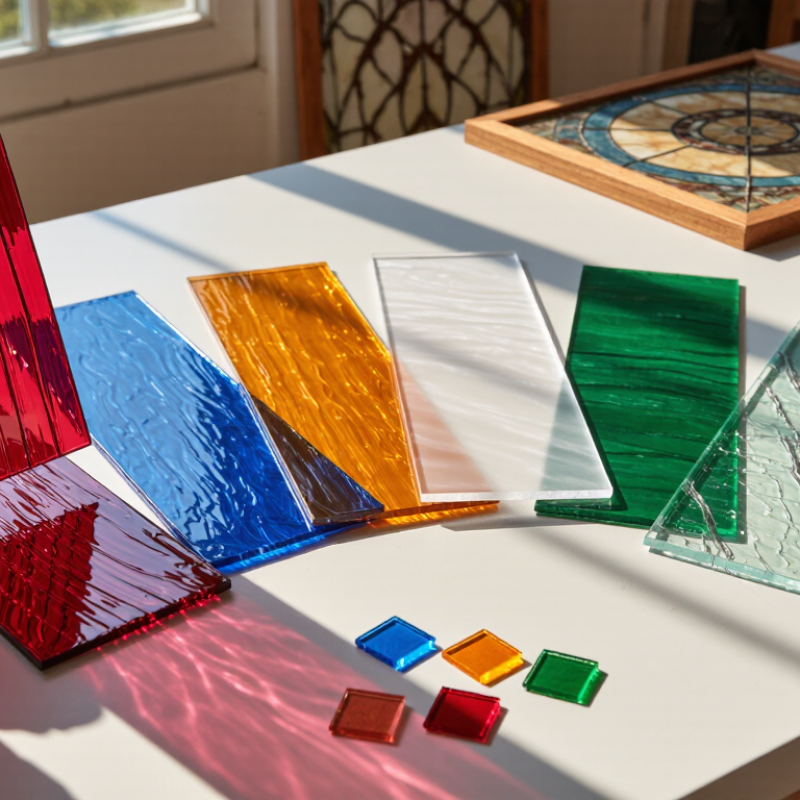
Identify the exact product line before choosing a sheet. Read the full series name, item code, and compatibility note on its label or supplier specification. Color and surface texture are useful clues, but they cannot confirm a glass formulation. A pale blue sheet may look identical across two lines and behave differently in a kiln. A color card is not enough. Record the item code and batch number, then check that information against the current technical sheet. It is easy to trust a familiar color; that shortcut can fail.
Confirm that the sheet is rated for COE 96, not merely described as “compatible.” Under the common studio convention, COE 96 represents a nominal expansion of about 9.6 × 10⁻⁶ per degree Celsius. A difference of 10 COE points equals roughly 1.0 × 10⁻⁶ per degree Celsius. That may sound small, but mismatched expansion can leave stress inside a fused piece. ASTM International’s ASTM C372-94(2020), Standard Test Method for Linear Thermal Expansion of Glass, describes a method for measuring this property. Use supplier data for the exact sheet, and avoid mixing lines based only on appearance. When documentation is missing, pause and verify it; a test tile may help, but it does not replace confirmed compatibility. I still leave room for doubt here. Labels can be misread.



Copyright © CUSTOM Building Products 2025
Products | Resources | Interactive Tools | Warranties | Privacy Policy | Terms of Use | Technical Training
