

How to Choose the Best Smart Sink Faucet?

Choosing the best Smart Sink Faucet requires more than comparing touchless features or glossy finishes. It demands evidence, careful measurement, and realistic expectations.

The U.S. Environmental Protection Agency’s WaterSense program reports that certified bathroom faucets use no more than 1.5 gallons per minute. That limit can reduce water use by at least 30% compared with standard 2.2-gallon-per-minute models. Kitchen faucets may follow different performance standards, so buyers should verify the certification directly. Marketing language is not enough.

Industry forecasts from Grand View Research and Fortune Business Insights indicate continued growth in smart faucet demand. Yet market growth does not guarantee better performance in every home. A powerful sensor may struggle beneath a deep cabinet. A voice function may become useless when Wi-Fi fails. Small details matter.

Industrial designer Dieter Rams offered a useful principle: “Good design is as little design as possible.” His idea applies here. The best Smart Sink Faucet should activate cleanly, control temperature accurately, and remain dependable during ordinary tasks, such as rinsing vegetables or filling a heavy pot. It should also allow manual operation when technology misbehaves.

Look for trusted certifications, replaceable batteries, durable finishes, and clear warranty terms. Check the spout reach against your sink before purchasing. Review privacy policies for connected models. No checklist is perfect. However, combining expert design thinking, WaterSense guidance, and hands-on kitchen experience creates a more reliable path to the right choice.
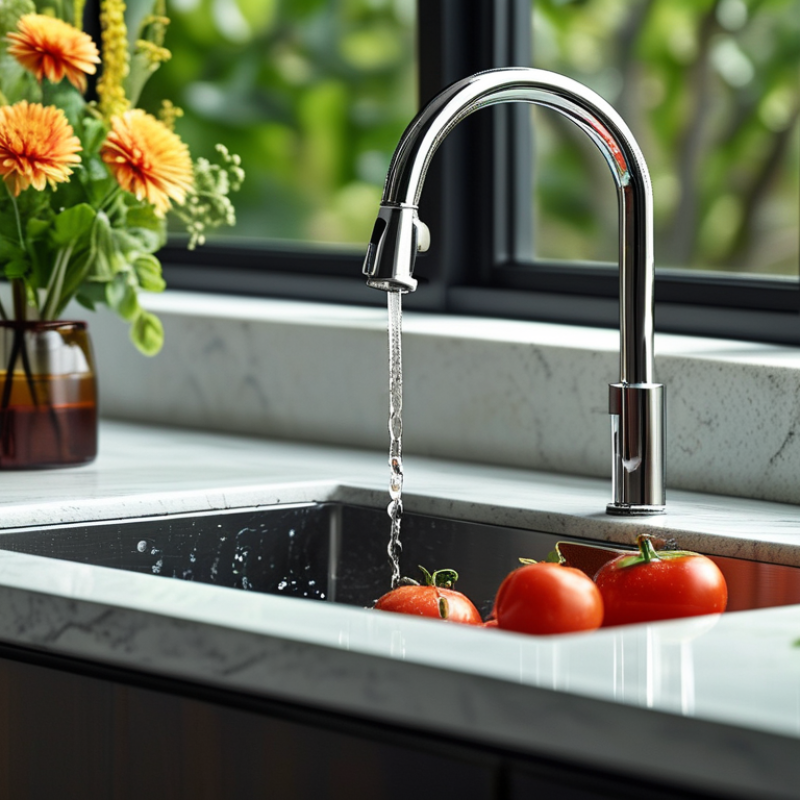
How to Choose the Best Smart Sink Faucet?

Define Your Use Case: Touchless, Voice, or App-Controlled Operation

How to Choose the Best Smart Sink Faucet?

Define Your Use Case: Touchless, Voice, or App-Controlled Operation

Choosing a smart sink faucet starts with your daily routine, not its feature list. A touchless model suits cooks with flour-covered fingers or raw food on their hands. A quick wave can start the water without spreading mess across the handle. Keep the sensor near the bowl, but away from strong sunlight and reflective surfaces. Otherwise, the faucet may react at the wrong moment.

Voice control feels convenient when both hands are occupied. You might ask for a gentle flow while holding a heavy pot. However, microphones can misunderstand commands over running water, fans, or conversation. Test the required phrases before installation. Simple commands work better than complicated ones. A physical handle should remain available.

App-controlled operation offers schedules, flow adjustments, usage records, and maintenance alerts. It can help monitor water habits in a busy household. Yet an app adds another dependence: your phone, network, and account must work together. Check whether basic operation continues during an internet outage. Review permission settings carefully. A reliable faucet should not require unnecessary personal data.

Think about cleaning, battery access, and local installation conditions. A sensor covered by soap residue may become inconsistent. Batteries hidden under a crowded cabinet can be annoying to replace.

I once underestimated cabinet space during a renovation. The faucet worked well, but maintenance became awkward. That small mistake changed how I judge smart kitchen equipment.


Match Flow Rate to EPA WaterSense Limits: 1.5 or 1.8 GPM

How to Choose the Best Smart Sink Faucet?

Flow rate matters more than voice control or motion sensors. EPA WaterSense specifications limit qualifying bathroom faucets to 1.5 gallons per minute at standard pressure. The U.S. Department of Energy lists 2.2 GPM as the older federal baseline for many faucets. EPA reports that WaterSense-labeled faucets can use about 30% less water than standard models. That difference becomes visible at the sink.

A 30-second handwashing cycle uses about 0.75 gallons at 1.5 GPM. At 1.8 GPM, it uses 0.9 gallons. Ten daily cycles create a difference of roughly 548 gallons annually. Small? Not really. For bathroom sinks, choose 1.5 GPM to align with the WaterSense target. For kitchen sinks, 1.8 GPM may provide better rinsing for pans and food residue, but it may not meet the 1.5 GPM bathroom specification.

Check pressure before deciding. EPA testing commonly evaluates performance at 20 and 60 psi, while household pressure can fluctuate. A sensor faucet may feel weak when its aerator clogs. That detail is easy to miss. I would test the stream with a full basin and wet hands, not just an empty sink. A lower flow rate can feel inconvenient during heavy cleaning. That is the trade-off worth reconsidering. EPA’s WaterSense Technical Reference materials and DOE efficiency standards provide useful comparison points before purchase.

How to Choose the Best Smart Sink Faucet? — Match Flow Rate to EPA WaterSense Limits: 1.5 or 1.8 GPM
Comparison Dimension 1.5 GPM Faucet 1.8 GPM Faucet Selection Guidance
Flow Rate 1.5 US gallons per minute
(approximately 5.7 L/min)
1.8 US gallons per minute
(approximately 6.8 L/min)
GPM describes the maximum water volume delivered per minute under the stated test conditions.
EPA WaterSense Relationship Matches the WaterSense maximum flow rate for qualifying bathroom faucets at 60 psi. Exceeds the 1.5 GPM WaterSense maximum for qualifying bathroom faucets. For a bathroom lavatory faucet, choose a model specifically certified to the current WaterSense specification.
Typical Best-Fit Location Bathroom lavatory, guest bathroom, powder room, and other hand-washing sinks. Kitchen, utility, or workshop sink where faster filling and rinsing may be more important. Confirm the applicable local plumbing code and product category before selecting the flow rate.
Water Used at 5 Minutes per Day 7.5 gallons per day
(approximately 28.4 L/day)
9.0 gallons per day
(approximately 34.1 L/day)
The calculation assumes the faucet runs continuously for five minutes each day.
Estimated Annual Water Use 2,737.5 gallons per year
(approximately 10,363 L/year)
3,285 gallons per year
(approximately 12,436 L/year)
Based on 5 minutes of operation per day for 365 days. Actual use depends on habits and sensor settings.
Potential Difference in Annual Use Can save approximately 547.5 gallons per year
(approximately 2,073 L/year) compared with 1.8 GPM.
Uses approximately 20% more water than a 1.5 GPM faucet when operated for the same amount of time. Reducing operating time with an automatic shutoff can produce additional savings at either flow rate.
Filling and Rinsing Speed Lower flow may take about 16.7% longer to deliver the same volume than a 1.8 GPM faucet. Delivers the same volume about 16.7% faster than a 1.5 GPM faucet. Choose the higher rate only when the sink’s task requires additional flow and the product is permitted for that application.
Smart Features to Check Hands-free sensor, timed shutoff, temperature memory, adjustable sensor range, and low-battery alert. Hands-free sensor, timed shutoff, temperature memory, adjustable sensor range, and low-battery alert. Smart functions do not automatically make a faucet WaterSense-compliant; the maximum flow rate and certification must also meet the applicable requirements.
Pressure Consideration WaterSense faucet flow is evaluated at a specified pressure, commonly 60 psi for the bathroom faucet requirement. Actual flow may vary with household pressure, aerator design, supply-line restrictions, and shutoff-valve position. Do not compare advertised flow rates without checking the test pressure and product specifications.
Recommended Choice Best choice for a WaterSense-focused bathroom installation and everyday hand washing. Consider for a kitchen or utility application when the higher flow is useful and local requirements allow it. For the best smart faucet, match the flow rate to the sink’s purpose rather than choosing solely by sensor or voice-control features.
Important Note EPA WaterSense labeling applies to specific product categories and certification requirements. A 1.5 GPM flow rate alone does not prove certification, while a 1.8 GPM bathroom faucet does not meet the 1.5 GPM WaterSense maximum. Always verify the current certification, installation category, and local plumbing requirements.

Verify NSF/ANSI 61, ASME A112.18.1, and NSF/ANSI/CAN 372 Compliance

How to Choose the Best Smart Sink Faucet?

A smart sink faucet should be judged by water safety, not only sensors or voice controls. Check whether its water-contacting parts comply with NSF/ANSI 61. This standard evaluates materials that may affect drinking water quality. Look closely. The certification should cover the exact faucet model, not merely a similar product family.

Verify ASME A112.18.1 compliance as well. This plumbing standard addresses supply fittings, including performance, durability, and construction requirements. A faucet may look impressive but still fail practical testing. Ask for evidence. Look for a current certificate, testing laboratory, model number, and certification scope. If a seller provides only a marketing phrase, pause before purchasing.

NSF/ANSI/CAN 372 focuses on lead content in plumbing components. It supports safer material selection, especially where water may be used for cooking or drinking. Remember, this standard does not prove every smart feature is reliable. Check the valve, hoses, connectors, and internal passages separately when documentation allows. A qualified plumber can compare the paperwork with the installed parts. That detail matters. I would also inspect the certification date, because standards and product designs can change. Perfect verification is not always easy, but careful questions reduce avoidable risks.

Compare Sensor Accuracy, Power Options, Connectivity, and Data Privacy

How to Choose the Best Smart Sink Faucet?

Sensor accuracy matters most at the sink. A delayed shutoff wastes water and frustrates users. Test the faucet with wet hands, dark sleeves, and different approach angles. Measure activation distance and response time with a phone stopwatch. These results are practical, but not laboratory-grade. I would repeat each test ten times because one perfect activation proves very little.

Power options deserve equal attention. Battery models simplify installation but need replacement planning. Wired models offer steadier operation, though outlets under sinks can face moisture risks. Choose a manual override for power failures. Connectivity adds convenience, but it also expands exposure. IoT Analytics estimated 18.8 billion connected IoT devices worldwide in 2024. That scale makes basic security decisions important, even for a kitchen faucet. NISTIR 8259A recommends protecting device data, managing configuration, and reporting cybersecurity status. Those principles apply here.

Tips: Prefer local controls over cloud-only operation. Check whether the faucet works without Wi-Fi. Read the privacy policy before pairing it with an app. It should explain collected data, retention periods, and deletion requests. ENISA’s baseline guidance stresses unique credentials, secure updates, and minimized data collection. Avoid models that request location access without a clear reason. Also inspect update support dates. A sleek interface cannot repair abandoned software. My own checklist would include sensor response, battery access, offline operation, encryption, and data deletion. I might still overlook something; privacy settings are often harder to understand than installation.

How to Choose the Best Smart Sink Faucet?

Compare sensor accuracy, power options, connectivity, and data privacy before choosing a smart faucet.

Scores are out of 100 and represent a practical comparison of common product architectures. Higher scores indicate better performance or flexibility. Sensor accuracy reflects reliable activation and reduced false triggers; power options favor faucets supporting both mains power and battery backup; connectivity considers local and wireless control; privacy favors local processing with minimal cloud dependence. Always verify the specifications and privacy policy of the individual product.

Assess Installation Fit, Maintenance Needs, Warranty, and Replacement Parts

Choosing the best smart sink faucet starts with measuring the installation area, not browsing features. Check the number of mounting holes, deck thickness, and clearance beneath the sink. A faucet may fit the countertop but still block the supply valves below.

I once selected a model with convenient touch control and ignored cabinet space. The control box pressed against a filter housing, making repairs frustrating. That mistake taught me to photograph the cabinet interior and measure every obstruction. Confirm power options too. Battery compartments should remain reachable after installation. If an adapter is required, keep it away from dripping connections.

Maintenance needs deserve equal attention. Look for removable aerators, accessible sensors, and smooth surfaces around the spout. Hard-water deposits can weaken spray performance within months. A soft cloth and diluted vinegar may help, but always follow the care instructions. Avoid assuming “smart” means maintenance-free. It does not.

Read the warranty carefully. Check coverage periods, installation exclusions, labor limits, and proof-of-purchase requirements. A long warranty sounds reassuring, yet difficult claims can reduce its value. Replacement parts matter more than impressive features. Confirm that cartridges, sensors, seals, hoses, and control units remain available. Ask how long parts are expected to stay supported. Keep the manual and installation receipt. Small details matter.

Resources

Copyright © CUSTOM Building Products 2025
Products | Resources | Interactive Tools | Warranties | Privacy Policy | Terms of Use | Technical Training