



Double Head Bolts are small components with demanding jobs. They anchor flanges, machinery, and structural assemblies where one threaded end enters a base and the other secures a part. Buyers often compare thread accuracy, steel grade, heat treatment, coating, and dimensional consistency. A clean thread matters. So does the inspection record behind it.
The market context is significant, but it needs careful interpretation. Grand View Research estimated the global fasteners market at USD 90.6 billion in 2023 and projected a 4.5% compound annual growth rate from 2024 to 2030. That figure covers many fastener types, not Double Head Bolts alone. It signals broad industrial demand, rather than proving the scale of this specific product category. For technical screening, ISO 898-1 provides mechanical-property requirements for carbon and alloy steel bolts, screws, and studs within its scope. Buyers should still confirm that a supplier’s test documents match the ordered material, dimensions, and intended application. A certificate is useful. Traceability matters more when a batch is rejected or a fit is wrong.
This overview of China’s top ten manufacturers considers product range, production capability, quality controls, and export experience. These factors help narrow a supplier shortlist, but a ranking cannot replace factory verification or sample testing. Catalogs can look polished. Real performance is less tidy. The right manufacturer is the one that can consistently deliver the required thread, strength, finish, and documentation—and explain what happens when it cannot.
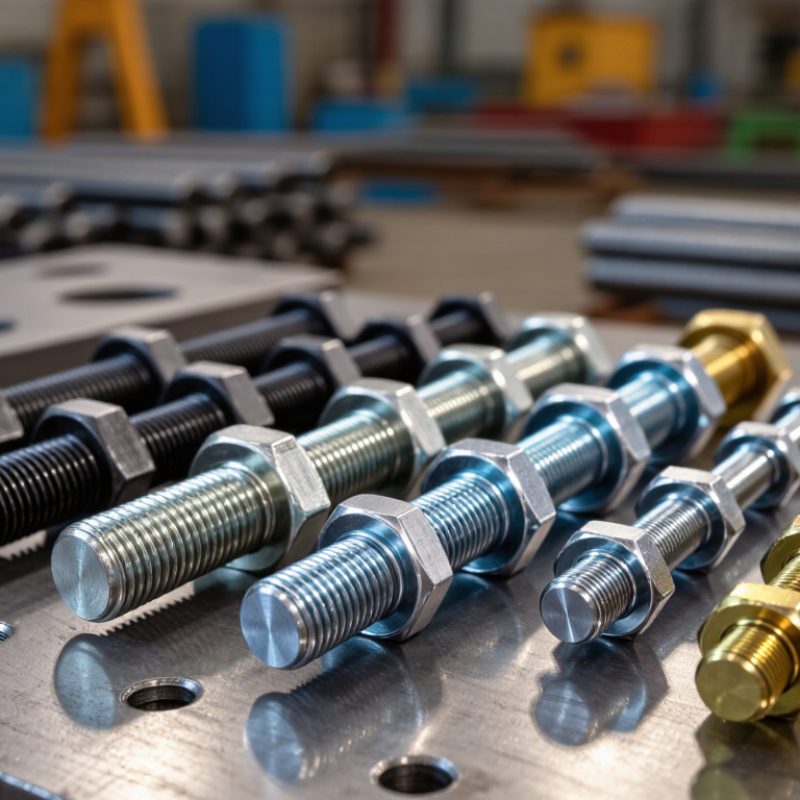
A double head bolt, often called a double-ended stud, has threaded ends rather than a conventional bolt head. One end may seat in a tapped hole or remain fixed in an assembly; a nut secures the other end. Some designs include a smooth central shank. That section helps locate parts, but its dimensions must match the joint. In practice, the name is not always used consistently. Check the drawing, thread lengths, and material specification before ordering.
Unlike a headed bolt, a stud can leave its nut-side threads accessible when the joint is assembled. A screw usually drives directly into a threaded hole, while a stud typically works with a separate nut. The distinction matters during maintenance: a damaged stud can sometimes be replaced without turning a bolt head inside a crowded space. ISO 898-1 classifies mechanical properties of carbon and alloy steel fasteners; class 8.8 denotes a nominal tensile-strength level of 800 MPa. Actual requirements depend on product dimensions and the applicable specification. The wider market shows the scale of this hardware category: Grand View Research valued the global industrial fasteners market at about USD 90.4 billion in 2023. That figure covers many fastener types, not double head bolts alone. A useful reminder. A matching strength class does not, by itself, guarantee a suitable joint.



Copyright © CUSTOM Building Products 2025
Products | Resources | Interactive Tools | Warranties | Privacy Policy | Terms of Use | Technical Training
