



Choosing the best Football Fake Turf in 2026 is not a color-chart decision. It is a performance decision made under real boots, changing weather, and repeated play. Grand View Research valued the global artificial turf market at about $4.23 billion in 2023 and projected 6.4% annual growth from 2024 to 2030. That figure covers multiple uses, not football turf alone, so it signals market momentum rather than proving which pitch performs best.
Look closer.
FIFA’s Quality Programme evaluates football turf through tests including ball roll, shock absorption, vertical deformation, and rotational resistance. These measurements matter on the field: a pass should not race away unpredictably, and a planted boot should not feel locked in place. Penn State turfgrass researcher Dr. Andrew McNitt’s published work offers a useful reminder: assess synthetic surfaces through measured performance, not appearance alone. That is a paraphrase of his research, not a direct quotation.
For buyers, the details are tangible. Check fiber shape and height, infill consistency, backing strength, drainage, and the system’s test results. Ask how the surface performs after heavy use, not just when it is newly installed. A plush sample under showroom lights can still play too fast or feel unforgiving. No turf system is perfect. Even a FIFA-tested product may suit one climate and budget better than another, and test results do not replace careful installation or maintenance. This guide compares the evidence and practical trade-offs behind the leading options for 2026.
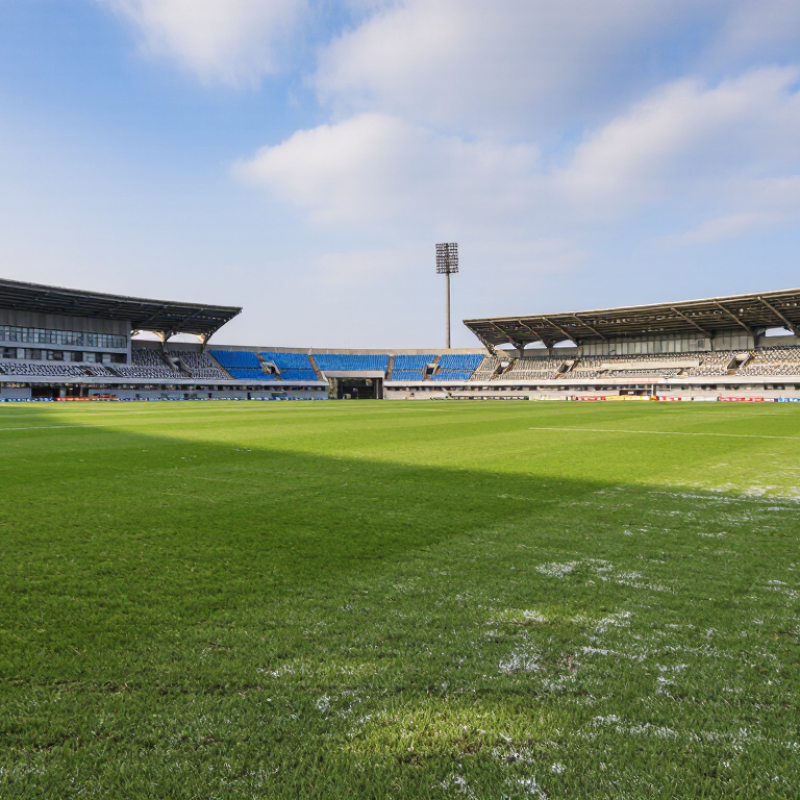
Football fake turf is a manufactured playing surface, not a carpet laid over dirt. Synthetic fibers are fixed into backing, with infill and often a shock-absorbing base beneath them. Natural grass is a living system: blades grow from soil, roots anchor the surface, and moisture affects its firmness.
The difference shows up underfoot. Turf can stay more consistent with frequent use, while grass may become muddy, uneven, or thin near goal mouths. Still, consistency is not the same as realism.
FIFA’s Quality Programme evaluates football turf using ball-roll, ball-rebound, shock-absorption, and rotational-resistance tests. Its technical requirements include ball-roll distances of 4–8 metres and vertical ball rebound of 0.6–1.0 metres (FIFA Quality Programme, Football Turf Handbook).
Natural grass has no single factory-set response; mowing height, soil compaction, drainage, and weather all matter. On a wet evening, a boot may cut into soft sod; on dry ground, the same grass can feel hard.
Turf can offer predictable ball movement, but infill may shift and fibers wear. That detail gets missed. Choosing between surfaces means weighing maintenance and playing feel, not assuming synthetic turf is automatically superior.


Copyright © CUSTOM Building Products 2025
Products | Resources | Interactive Tools | Warranties | Privacy Policy | Terms of Use | Technical Training
